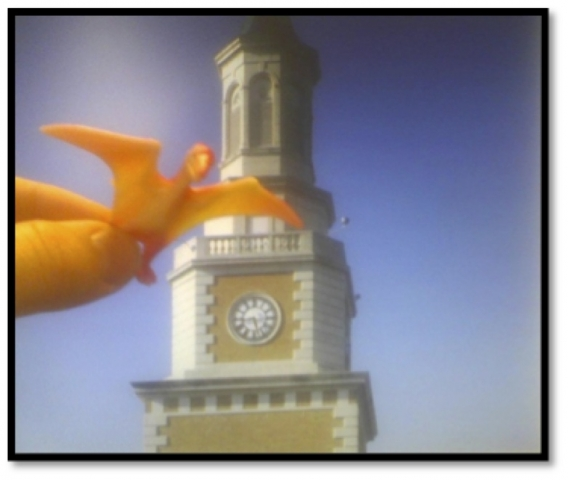
As you may have heard, the University of North Texas was invaded by pterodactyls on Monday.
My colleague @LeslieWimmer originally masterminded the idea for a mock-invasion of the campus after seeing the Center for Disease Control’s Zombie Apocalypse preparedness tips last May. The idea percolated for a few months until our supervisor encouraged Leslie and me to put our ideas into plan form.
At that point, we brought UNT’s resident “social media guy” @LandonSloan into the fold and began developing a strategy for this quirky mock-invasion. The goal was to show a lighter side of the university, while also promoting awareness of our safety procedures and resources. The project also served as a platform to promote increased engagement on our university Twitter account and Facebook page.
In the end, the project included a spoof news release, pterodactyl safety tips (Leslie did a great job on these – hilarious!) and a public service announcement featuring Scrappy. Students seemed to enjoy the silliness and began submitting their own photo-shopped images of pterodactyls on campus. The success of the campaign gives us some fuel to pursue some more creative engagement strategies in the future.
We had a great time doing something a little out-of-the-box, and also learned a lot. Here are a few things I took away from the experience:
Pay attention to trends
Originally, we were thinking of having the campaign feature zombies, but one of our supervisors challenged us to come up with something more unique. We were glad we shifted to pterodactyls when Halloween rolled around and a number of companies and schools launched projects featuring zombies. Zombies, though cool, weren’t fresh in the world of social media anymore.
Start small
Project Pterodactyl strayed from the traditional tactics typically used by my office, and in our excitement about the project it would have been easy to overdo it. A lot of ideas were thrown around, but in the end we decided that we needed to test the waters with something relatively simple.
Have a contingency plan
When Halloween arrived Leslie was the only member of our team actually at work. Landon had come down with a bug and was out sick. And my husband blew out his knee at work the night before, so I ended up working from home. We were able to make everything work thanks to remote desktop connections and pre-planning, but the circumstances highlighted the importance of having a back-up plan.
Have an exit strategy
By about 4 p.m. the chatter about pterodactyls had slowed. Leslie and I found ourselves asking, “how should we end this?” We decided to send a tweet thanking our followers and letting them know the loss prevention task force had the pterodactyl situation under control. The ambiguity of the end of the day emphasized the necessity of a thorough and complete plan.
Be specific on metrics for evaluation
Since this was the first time that we’d done something of such a creative nature, we weren’t sure what kind of response to expect. Thus, we didn’t put a lot of specific metrics into our plan, which made it difficult to define the success of the program. Although we were thrilled with the participation and interest in the event – we now know that we need to more clearly define success for future endeavors.
 Alyssa Yancey